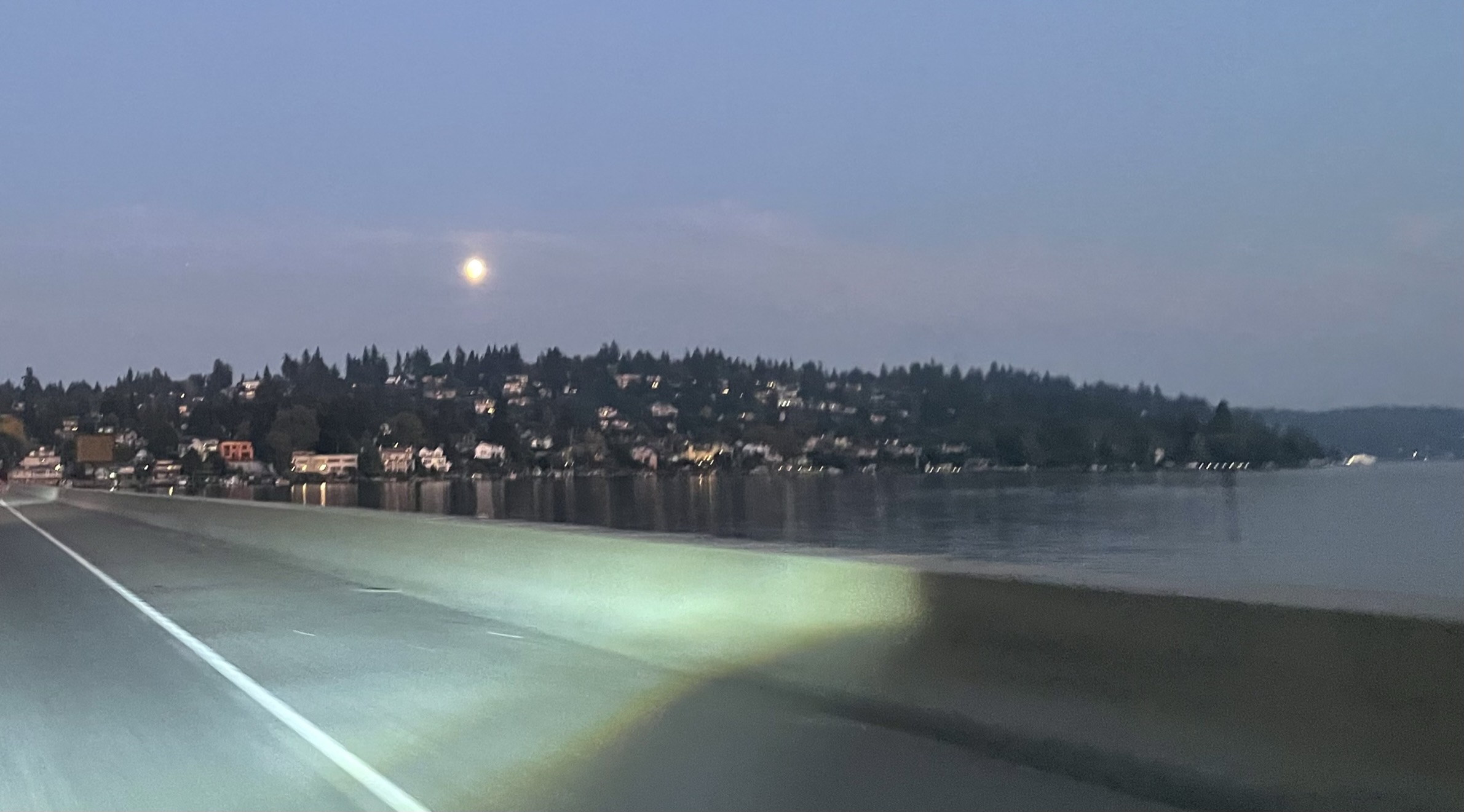
Living with retinitis pigmentosa
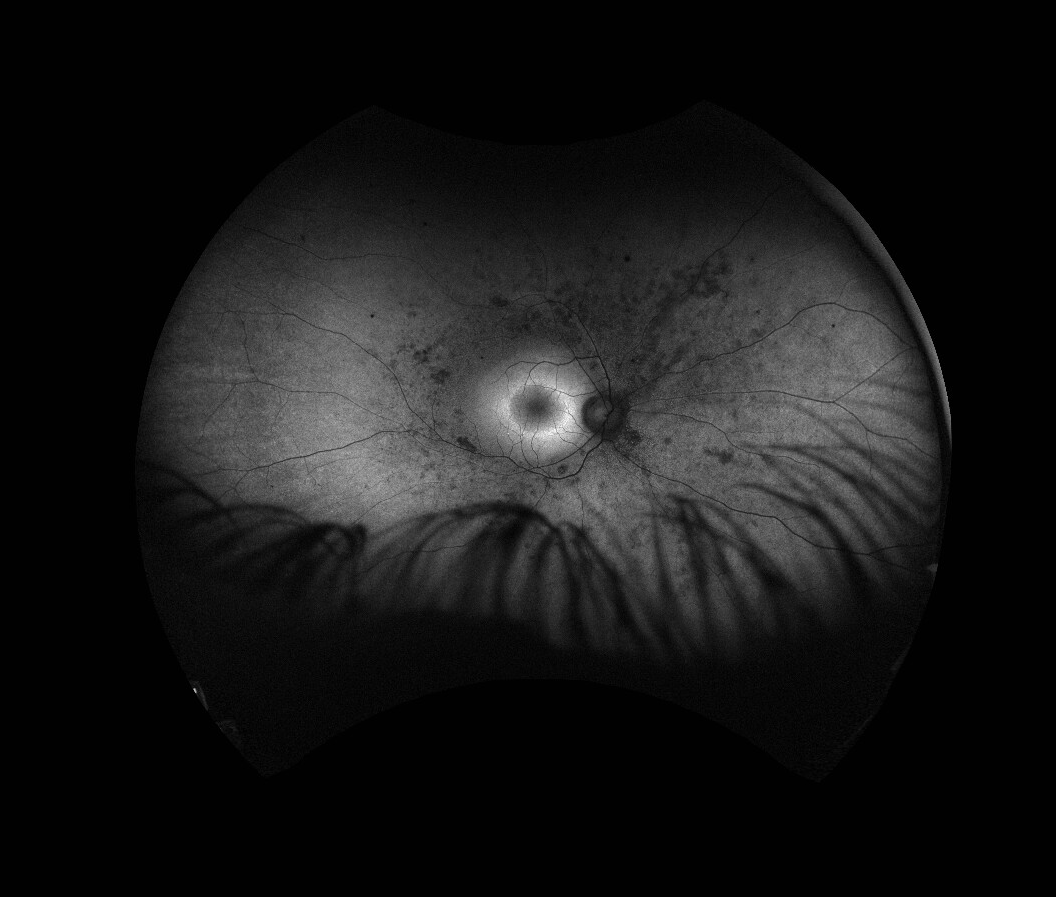
Like most people living with retinitis pigmentosa, my first symptom was nyctalopia.
I first noticed my relatively poor night vision when I was nineteen. There was a girl I brought home one night. She waved her hand in front of my face, expecting me to laugh. “Can you not see me waving my hand in front of you”, she asked. “No”, I said, “can you see well in here?” She fell quiet. “Yeah”, she said, “I . . . can see you clearly”.
I relocated to NYC from Virginia in 2018. I soon realized I couldn’t navigate nightclubs or bars with my friends like I used to. I tried going out and living my life anyway. I love dancing, electronic music, meeting new people, supporting a couple of my friends who DJ, and so on. Eventually, however, dimly lit environments became too stressful for me to hold normal conversations, recognize facial expressions and cues, find the bathroom, find my way back to my friends from the bathroom, and so on. Except for thinly patroned bars, I basically stopped going out. Friends began making it a point to find well-lit venues, bars, and restaurants whenever we went out together. It’s been like this for a long time.
It wasn’t until June of 2025 my vision began “tunneling” – losing peripheral vision, that is. What was relegated to nighttime all of a sudden became a daytime problem. I was walking through Union Square one morning when I observed my peripheral vision had vanished abruptly. I experienced a panic attack so severe, I felt like I had to sit down. And I almost never experience anything like anxiety or panic attacks.
I visited an ophthalmologist maybe a week later. He checked my retinas, sat in front of me, placed his hands on my knees and solemnly said “I’m so sorry”. He urged me to schedule an appointment with a retinal specialist in Manhattan immediately. “I don’t normally see this condition”, he said, “so I don’t feel comfortable diagnosing it”. So I called and scheduled an appointment for August.
August rolled around and I was officially diagnosed with retinitis pigmentosa in what seemed like remarkably little time. “You have retinitis pigmentosa with concomitant macular edema”, the specialist said, “so I want you to be checked out by the specialists at Columbia University”. He was referring to the retinopathy center at Columbia, which is a serious research and treatment institute – which worried me. So I called and scheduled another appointment.
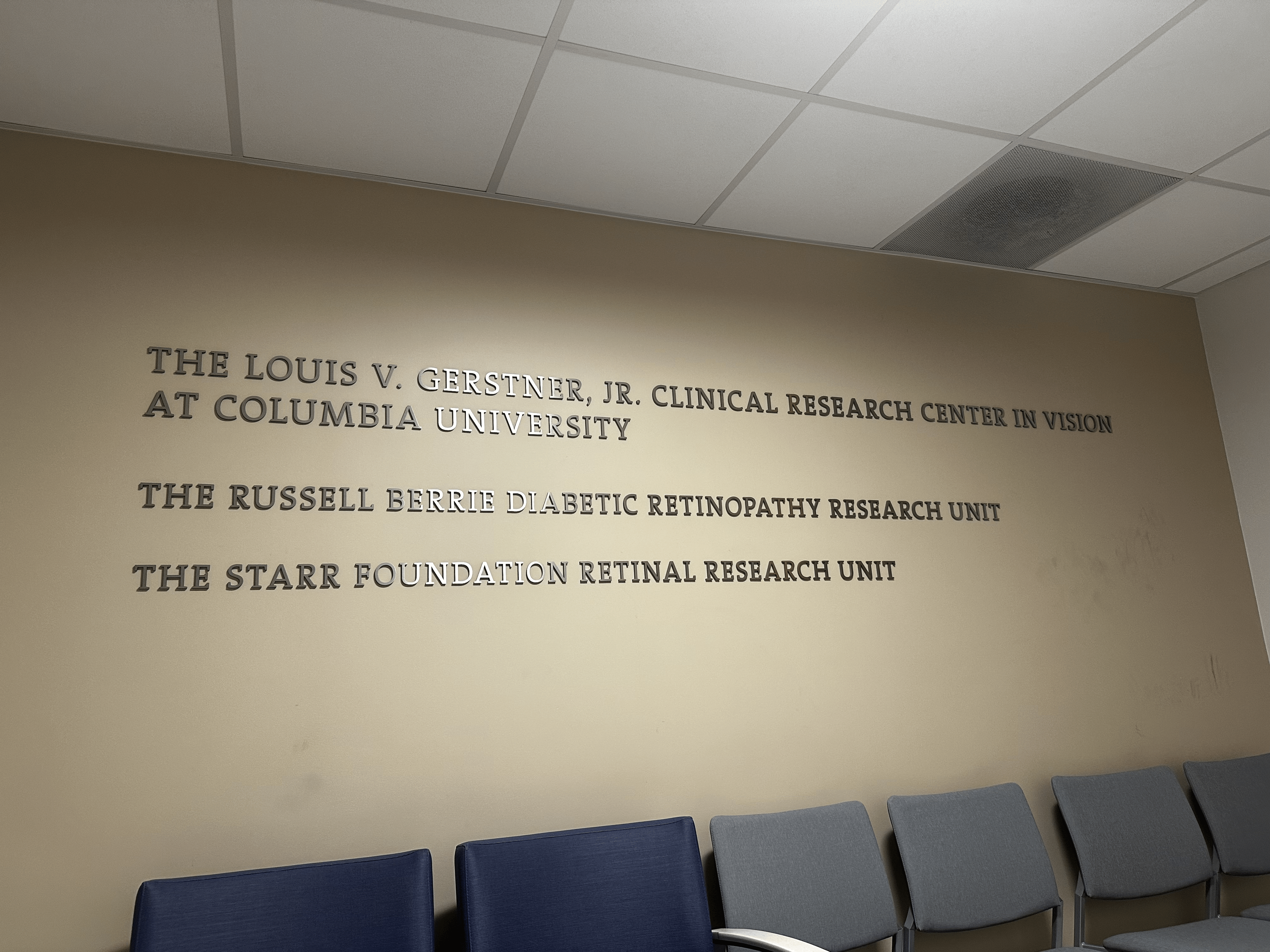
I showed up to my appointment at Columbia University and my retinas were checked again. The office was strange. There aren’t private rooms. Instead, you sit next to your doctor’s computer in the middle of an office, and you try not to remark on the fact he still uses Stata in 2025.
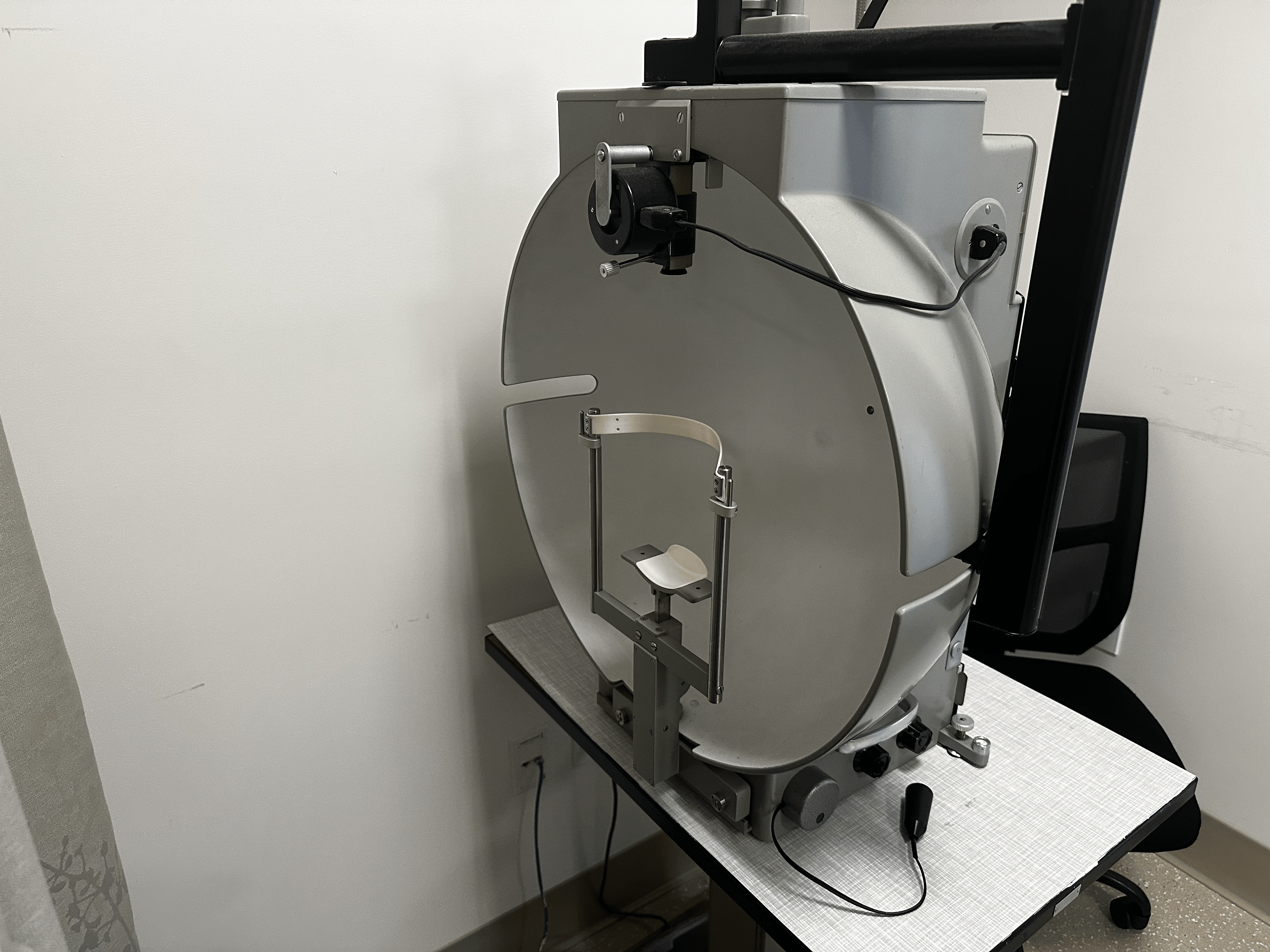
This is what a Goldmann Perimeter machine looks like.
And then I came back to Columbia again in December, and I got checked again. This time with what’s called a Goldmann Perimeter Machine. It’s like a video game. You press a button each time a glowing dot enters your field of vision. It’s a mentally exhausting test, surprisingly. At least for somebody with bad eyes.
“It’s unsafe for you to operate motor vehicles”, my doctor told me. “I know you have an off-roading vehicle. You should probably sell it. I’m sorry. I won’t tell the DMV, but your insurance will know. If you get into an accident and I’m called into court, I won’t be able to defend you. I’m genuinely sorry”, he said.

Retinitis pigmentosa is strange.
In the first place, you don’t lose your peripheral vision such that there’s a neat little circle left in the middle. You lose it in patches. In my right eye, for instance, I still have peripheral vision on the right-hand side. But in the lower quadrant – nothing’s there.
In the second place, you can technically be diagnosed without genetic testing; however, that diagnosis is under-determined until genetic tests evince the specific pathology. It’s less like “you have RP” and more like “gene [x] is pathogenic and known to correlate with RP”, if that makes sense.
I received the results of my genetic test in January. Besides some fascinating tidbits about my family heritage, the pathogenic variant causing all of my trouble is evidently called RHO (c.68C>A (p.Pro23His)), which is known to cause autosomal recessive sideroblastic anemia and, of course, retinitis pigmentosa (with erythrocytic microcytosis).
The good news: RHO is the most common pathology (globally!) among people diagnosed with retinitis pigmentosa (particularly for people with Northern European heritage). This means there’s a greater likelihood of future efficacious treatments.
The bad news: “RHO (c.68C>A (p.Pro23His))”, “autosomal recessive sideroblastic anemia”, “erythrocytic microcytosis” – this is waaaaay too many words for my Jeff-Koons-sculpture-like-smooth brain to remember. (Honestly, doc, haven’t I suffered enough?)
The existentially terrifying news: as I alluded to above, there’s no known cure.
Having retinitis pigmentosa means I have a low-vision disability. Because the condition’s rare and there’s no cure, having retinitis pigmentosa (or macular degeneration more generally, which encompasses several other diseases too) places me in a global community of researchers and patients. There’s an online platform I was asked to join so I could learn about and evaluate clinical trials. It shows a dashboard of everybody (that we know of anyway) who is diagnosed with RP. Which is kind-of cool, albeit macabre.
Remarkably, I’ve met two people (organically!) who also have retinitis pigmentosa. I met one at my gym (of all places!) and another on LinkedIn. We instantly became friends. They’re far worse off than I am. One has basically no field of vision remaining. The other has a little left, but he’s managed to have a great life/career anyway, which gives me hope. I’ll probably meet the criteria for “legally blind” in like one to three years (it’s impossible to know/say), but I’m basically there (i.e. mathematically one degree away) already.
I use a cane sometimes but generally don’t. To be blunt, I avoid using a cane as much as possible. I don’t want people to treat me differently, and I don’t want to deal with judging glares from people when they see me put the cane away (ask me how I know) because I only need it in certain situations.
Nobody seems to understand:
assert ("cane" == "full-hog-pitch-black-lights-out-holy-shit-youre-ineluctably-and-interminably-blind") is FalseThe percentage of blind people who can’t see anything is actually exceptionally rare. It’s like 1% of blind people altogether. The purpose of the sunglasses is roughly two-fold: give the eyes a break, and signal to others that your eyes are cooked so there’s no guesswork.
Altogether, this places me in the category of “invisibly disabled”, which brings a unique class of uncomfortable experiences.
- I miss handshakes and fist bumps constantly.
- I bump into dogs and children.
- My shins are covered in bruises.
- Commuting on the train and walking around Manhattan are stressful. (I’ve never been more grateful to live in Greenpoint, Brooklyn)
- I (probably) won’t be able to read somebody’s feelings in a dimly lit room, like a bar or restaurant, unless they intimate them to me tonally/verbally.
In general, daily life has become an experience of low-grade stress, frustration, and, rarely but nevertheless, humiliation. I live normally but basically everything I do is belied by low-grade frustration or embarassment.
I can’t take things for granted anymore. Diminutive tasks, like grabbing a straw from the bartray at a busy coffee shop without bumping into chairs or short people, have become accomplishments.
Then there’s the matter of my career. Sadly, it’s been impacted by RP (besides using a humongous cursor and 150% size font).
People bristle whenever they hear or read somebody describe themself like this, but I’ve earned the right to say it: I’m very talented at what I do and I work very hard.
I’ve had people candidly question if this anecdote is true: I reduced the runtime of a production system at Capital One from 55 hours to 7 seconds. Yes – that actually happened.
If you want to read that as bragging, knock yourself out. May I kindly suggest an alternative perspective: feeling happy I found an intersection between what I’m naturally good at and what I enjoy doing.
Whatever you choose, I’m making a point.
Finding the motivation to not only finish but crush my work was previously never a challenge for me, no matter what I was going through. Learning I was going blind – that I have a low-vision disability – and that there’s no cure abruptly changed that.
Being a spiritual-boomer, I never saw myself taking short-term disability leave. But, between August and October, I did. Not because I wanted to but because I found myself with no other choice. Understandably, my productivity plummetted. I couldn’t focus on anything. Etc.
I wanted to trust my employer would understand. But, upon returning to work, and without going into too many details, I’ve learned they don’t sympathize or understand. Which is remarkable because my skip-manager’s relative also has RP, but I digress.
If you care to wear my shoes for the next few minutes in order to understand what this journey has been like – to experience a small sample of what I’ve been going through, that is – then here’s one empathic portal you may walk through:

Imagine you dreamed from early childhood about some day owning a boxy Toyota with giant tires. You saw a Marlin Crawler advertisement in a magazine when you were eight and instantly fell in love. It’s cringe but the dream never died. You weren’t sure how but you knew some day you’d realize the dream. Suppose the dream was so meaningful and longstanding for you – you told nobody about it because you didn’t want anybody to ruin it, preferring instead to wait until the day when you can physically manifest the dream. Suppose you move to the West Coast for two years and bought an old, boxy Toyota that barely ran. Suppose your decision to move to the West Coast had, to a small degree, something to do with buying a truck like that. Suppose you dumped tens of thousands of dollars into building a machine which won car shows and crawls over massive rocks with ease. People on the highway hang out the window and ask, “tell me that’s got the five speed in it”. And you tell them it does indeed have the five-speed in it. Now imagine your doctor tells you about two years later you can’t drive again. Oh, and, by the way, there’s no cure. And it’ll get worse. Much worse. And you’ll consciously observe that and there’s nothing you can do about it. See you in two months. That’ll be two billion dollars.
I’ve accepted what lays ahead and survived the worst of this journey.
I’m not ashamed to admit I cried every single day for about four months, August through November.
I know I’m going blind. I know I’m at the proverbial edge of being designated “legally blind”. I know there’s little if anything I can do about it. I understand regenerative treatment is a pipe dream. I know there will probably never be a cure, artificial intelligence notwithstanding. I understand this. I understand that. I accept it all.
I was officially diagnosed just six months ago. I am proud of the progress I’ve made emotionally and practically in such little time. And I am proud of the fact I didn’t fall apart.
I formed an open-source collective. I continued maintaining my open-source projects. In fact, I created a new one. I’m even working on another in my free time. I was also inducted to the AWS Community Builders program! I joked, smiled, and laughed with my friends. I showed love to the people I care about.
What made this journey exceedingly difficult, however, actually had nothing to do with my condition except indirectly.
There was an unexpected, abrupt, and extreme relational rupture which occurred during this whole period. There was no clear cause or reason, and I had no way of seeing this coming. I tried asking what was wrong, but all anybody could offer was speculation. They never explained themself directly. More, my efforts to repair and heal the situation inexplicably made matters worse. Every kind, patient, and empathetic impulse I had cultivated over the course of my life, which had always served me well, suddenly seemed like a problem to somebody. I had never experienced anything like this before, and I doubt anything like this will ever happen again in my life. I don’t think I know anybody who has experienced anything like this either.
It’s a strange, confusing, and frankly ineffable situation in the sense there’s very little anybody involved actually knows or understands. What little we “know” – doesn’t make sense. However, I was later told by somebody who knows this old friend well that they have struggled with emotional issues before – something I had no idea about when we met. Whatever the case, this experience added acute moral injury (I genuinely don’t know what else to call it) on top of everything else. I lost a friend who I genuinely admired and who I couldn’t help. I don’t even know why. Nobody does. I asked many times. For weeks, I looked inward, scrutinized myself and my actions, and so forth. But I found nothing. It’s unsettling to consider the possibility they explained nothing because they may not be able to articulate what was wrong themself.
To experience something so strange and terrible as this – to find yourself erecting indomitable boundaries with somebody you regarded as a special person, and to not even understand how you arrived at such an awful point – while going blind introduced a frankly mythical quality to the whole experience/memory of this period of my life. I reached out to this old friend as a well-intentioned reaction to my condition. Reaching out to old friends (they weren’t the only person I contacted), instead of withdrawing from the world and slinking into neurosis, seemed like a great idea. In all cases, except this one, I was glad I reached out to people. Reconnecting with an old friend who I held in high esteem was supposed to raise my spirit, not test it.
I’m not religious, but it was genuinely hard not to think at times like I was being tested by some cosmic entity to see if I would collapse. Or something ineffable like that. Being diagnosed with a permanently life-altering and incurable condition -> losing trust in my employer -> experiencing an inexplicable relational rupture – that’s a lot. Frankly, that’s rare. And not in the special, narcissistic invocation of the word rare.
I will regret publishing this post. It’s incredibly personal and vulnerable. But I’m going to force myself to leave it up, as uncomfortable as that is for me. A part of me wants people to know what I’ve been experiencing. Besides family and close friends, nobody knows. I’ve kept all of this to myself, quietly. But, again, a part me thinks people should know. I sometimes trust such thoughts blindly (pun intended).
Time will tell if sharing this information with you all was prudent or not. Either way, I’ll leave this post up. Whatever your take, you should probably know I have a low-vision disability. And it’s going to get worse. I can work. I can live. But going blind gradually has many implications for how I get around and how I relate with others, which you all should know about. Whether I like that or not.